51șÚÁÏ
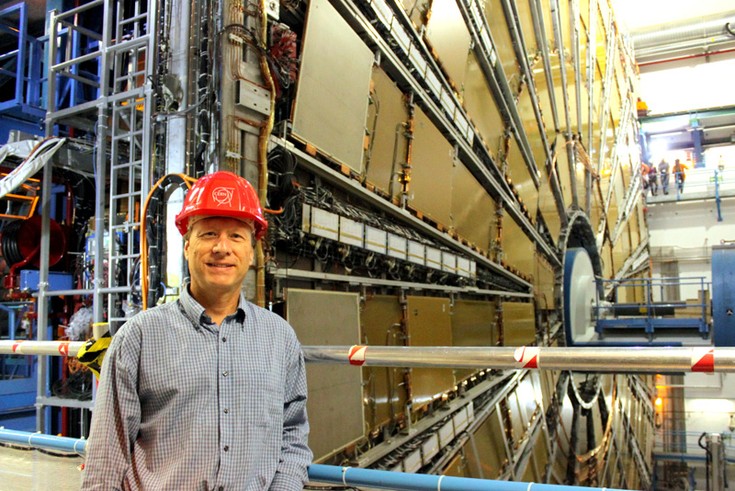
Michael G. Strauss (’81) arrived at Biola as an undergraduate who was interested in the intersection of science and faith. After graduation he applied to graduate school and seminary, and went on to receive his master’s degree and Ph.D. in experimental particle physics from UCLA.
But his love for the intersection of Christianity and science never went away. Even as he does research on the ATLAS detector at CERN (the European Council for Nuclear Research) near Geneva, Switzerland, and teaches at the University of Oklahoma as a professor of physics, Strauss travels the world speaking about faith and science.
“The thing that opens the doors is that God has equipped me to be a scientist working on some of the world’s most interesting problems,†Strauss said, including the research he’s conducted with physicists who discovered the Higgs boson particle, along-theorized elementary particle responsible for giving mass to other particles. “There are some outspoken atheistic scientists, and what I’ve been able to stand up and say is that good science points right to God, not away from God.â€
Much of Strauss’ scientific curiosity is rooted in his experience at Biola, where he was encouraged by Peter Kurtz, the only professor who taught physics courses before Biola offered a physics major.
“He showed an interest in me as a person and as a potential scientist,†Strauss said. “The first class I took that sparked my interest was quantum mechanics. The world at the size of atoms or smaller is totally different than the world we interact with at the macro level. I was intrigued with trying to find out about this subatomic world.â€
Biola’s focus on the sciences has significantly grown since the early ’80s, and Strauss — who now serves on the School of Science, Technology and Health dean’s professional advisory board — is excited about the growth and what’s still to come.
“I’m so excited about what’s going on at Biola in science,†Strauss said. “There was no way to see this in 1980 with one physics professor. We couldn’t attract students. They weren’t doing the harder sciences and there was this big gap, and now that gap’s been closed and the opportunities are tremendous. They’re literally societal changing.â€
Strauss, who served as one of four general editors of Zondervan’s Dictionary of Christianity and Science, hopes to inspire change through his new self-published book, , written to help a nontechnical person understand how modern science and Scripture fit together.
“It used to be that Christian scientists led in science,†Strauss said. “And this book could be a catalyst for Christians to retake science from a Christian worldview.â€