51黑料
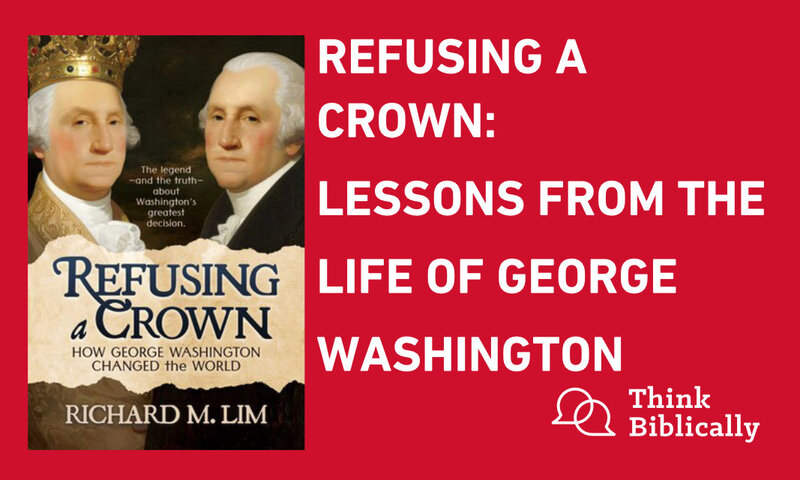
How significant was it that George Washington refused the pleas of the nation to run for a third term as President? How can we summarize the legacy of George Washington for American democracy? And what did George Washington think of the role of religion for civil society in the newly founded United States of America? We鈥檒l discuss these questions and a whole lot more with our guest, historian Richard Lim around his new book on the life and legacy of George Washington鈥�
Richard Lim is the cofounder and host of the This American President podcast and the resident historian at Prager University. He previously served at the White House, the Association of the United States Army, and George Washington鈥檚 Mount Vernon estate.
Episode Transcript
Scott Rae: [upbeat music] How significant was it that George Washington refused the pleas of a nation to run for a third term as president? How can we summarize the legacy of George Washington for American democracy? And what did George Washington think of the role of religion for civil society in the newly founded United States of America? We'll discuss these questions and a whole lot more with our guest today, historian Richard Lim, around his new book on the life and legacy of George Washington, entitled Refusing a Crown: How George Washington Changed the World. I'm your host, Scott Rae.
Sean McDowell: And I'm your co-host, Sean McDowell.
Scott Rae: This is Think Biblically from Talbot School of Theology, 51黑料. Richard, welcome. So glad to have you with us. So enjoyed reading your book. It was a terrific read, very well-written, super entertaining to read, and I know, I know it'll be a benefit to our listeners, so we're looking forward to diving into some things with you. First of all, what has, what has sparked your interest, in the first place, in the life and legacy of George Washington?
Richard Lim: Well, first, thanks for having me, and thanks for just your encouraging words. That's so rewarding for somebody who's worked on this book for years. So it was actually in a very unlikely place where I got interested in George Washington. It was a trip to China almost 20 years ago. I was with my family. It was a family reunion, meeting relatives I'd never even known existed, and, one of my cousins, he was actually my stepdad's cousin, he was talking about current events. I was talking to him. I didn't speak any Mandarin or Cantonese. He doesn't speak any English, so my dad was translating. He was talking about the big hot button issues at the time. It was mainly the Iraq War. He was very critical of American foreign policy. I just wanted to listen, hear someone's perspective. And out of nowhere, he mentioned he loved history, and that piqued my interest because I've been a history nerd since I was a kid. And he specifically said that the figure he admired the most is George Washington, and that really struck me because here we were, you know, 200 years after Washington lived, in a completely different society, different country, and he found something in Washington that he, really revered. And I spent the next couple decades trying to find out why that was, and I realized it was because that he gave up power, and that has a resonance, a power that Americans don't really realize that it has. To us, he's just the man on the dollar bill. He's just kind of part of the scenery. But that story that, of his life has so much power around the world.
Sean McDowell: Richard, I've been in other countries where people have, without being asked, lectured me about my country's politics.
Richard Lim: [laughs]
Sean McDowell: And more often than not, I just listen, ask questions, don't get as defensive as I would like. There's something about doing that. I respect [chuckles] that response for the sake of a larger goal. But your subtitle's fascinating. It says How George Washington Changed the World. Now, for a lot of people, it'd be like, "Come on, change the world?" But this just might be true with George Washington. So how exactly did he do that?
Richard Lim: No, that's a fair question. It's a grandiose thing to say, right? And you know, when you write a book, you have to make it compelling, so part of the reason, you want something that'll pique people's interest. But here's the thing. When we look at the Founding, it looks so linear. We get mad at a bunch of taxes. We declare independence. We win, create a Constitution, and we have a government, have a president. Well, part of greatness is making something look easy, right? And so, it really belies how unlikely the Founding was. Washington said it was a standing miracle, how throughout most of the Revolutionary War, it looked like they were going to lose. And the fact that Washington gave up power, to most people, it looks like, oh, okay, well, the war was over. He went back home, end of story. Well, if you look throughout history, nobody gave up power. Virtually nobody gave up power. Even to this day, you give a congressman a little bit of power over a district, and he's gonna turn it into an empire. He's gonna stay there for decades. We have politicians that have been there for life, and that's just, that's the, MO. That's the way politicians are. And leaders, they've also fudged it throughout history. I mean, you look at Caesar Augustus, who claimed that he was the first citizen. Even when he was emperor, he always had this fiction that, "I'm the first citizen." And you look at Oliver Cromwell, who said he wasn't a king, but in reality, he was. Well, George Washington was one of the first leaders in all of history to not fudge it, to actually do what he said he was going to do, to not be tempted. And not only that, but Washington had very clear ideas on what he felt were the best policies that the nation should undertake. And so many leaders have just kind of forced their way to make those policies a reality. Instead, he pulled back. He made his suggestions, but he let the people decide what kind of system of government they wanted. During his presidency, he let them decide who should succeed him. He didn't interfere in that, and that is really unprecedented. And even to this day, it goes against the grain of human nature.
Sean McDowell: Richard, just yesterday, I was talking to my students. I teach a class at Biola called Gospel Kingdom Culture, and we were talking about critical theory. And in critical theory, really, the problem in the world is just power differential. And so I asked my students, I was like, "What is a Christian or Biblical view of power?" And part of it is in Christ giving up that power, Philippians 2, and taking on the form of a servant, so it's either giving up power or using power for good. I realize I'm getting ahead of myself a little bit, but even that idea of what he did has just such Christ-like Christian undertones for it, power for the good of others rather than for the self.
Richard Lim: Yes, exactly. And it's one of those things that I talk about his circular in 1783. His... It would've been his farewell address had he not been president and issued his more famous farewell address. And he talks about how Americans, in order to succeed, need to imitate Jesus. Because as we know, Jesus being the author of all good, his sacrifice, you know, Washington's sacrifice obviously pales in comparison. It's a faint shadow of what Christ did. But he knew that as the source of all good, Christ was the one that we had to imitate in order for our nation to succeed.
Scott Rae: Now, Richard, you point out, I think, very interesting part of the book, you know, of course, the classic example of Washington refusing power was his choosing not to run for a third term when the nation was pleading for him to do so. But what would you say, what are... Are there other examples in his, during his presidency or during his, when he was the, basically the general for the revolutionary army, of his refusals to consolidate his power when he had the opportunity?
Richard Lim: Well, I would say that is the way he conducted himself throughout the entire war. He really had to lead the nation in an unprecedented way in all of history because you have this nation creating a republic, and it was, the, an experiment. It really was. Because republics had only existed in city states. People didn't think that you could have a free society in these large states, which were the size of European countries. And yet he had to take republican theory and turn it into practice. And so throughout the war, he, even though he was the commander-in-chief, he constantly deferred to the people's representatives. And this was a very chaotic time. It was during the Articles of Confederation. When you talk about who was the civilian master at that time, well, there were 14 of them. There was the national government, which was very ineffective, but he had to listen to them. And then there were the 13 states, and they were not coordinating very well. And so in a sense, he had 14 masters. And you have a Congress who was making a lot of bad decisions. They were promoting, And we all know that's what Congresses do, right? They were self-interested. They were corrupt. They were promoting foreign, officers over American officers that really angered. You know, talk about foreigners taking American jobs. And throughout that whole time, there was never a question about Washington's loyalty to the civilian authority, and he deferred to them even on military matters, to the point that Congress had to tell him, "Hey, just make a decision," right?
Scott Rae: [laughs]
Richard Lim: But it showed Washington, you know, his respect for republican principles. And I would say it wasn't just those one moments, giving up power at the end of the war, giving up power at the end of two terms. It was the fact that that's how he acted all the time, constantly. And again, he refused to influence the outcomes after the war, and he refused... There's a letter he wrote when he was president to somebody that was using his name during a campaign as if Washington supported him, and Washington was indignant. He said, "Look, the people are free to choose whoever they want without me interfering in their choice." And that's an incredible level of restraint. Nowadays, presidents endorse people left and right, but he refused to do that. He wanted the people to work it out on their own.
Scott Rae: Just a quick follow-up on that. It sounds like this was sort, this was just part of, part of the, of who he was, not just those monumental decisions, but part of the everyday aspect of who he was. Is there anything theological you think that undergirded his, you know, his refusal to consolidate power?
Richard Lim: Yeah, you know, it's interesting. There's been this long debate about George Washington's religious faith. And having studied him for many times, I mean, I would say that as we know, it's impossible to look into the heart. God knows. I don't know. I do know for a fact that Washington did identify as a Christian, and he grew up in the Anglican Church. He was active in it. And he affirmed, you know, the way an Anglican does when they go to church and they affirm all the oaths. And so for many Anglicans, that was a sufficient public profession of faith. Of course, you know, one's heart. Many of Washington's, loved ones affirmed that he was a Christian, as well as friends. His step-granddaughter believed that he was a Christian. I would say that when he talks about good policies and he talks about his decisions, he did often talk about God, using the term providence, and he talks about what his duty was, that he had a duty to God, man, and country. And so I do believe that he was working at a in a Christian context and in a very healthy Christian context, Biblical. As far as whether he believed, again, you know, I'm not gonna say for sure that I know, but, I believe that at the least he was very influenced by that, Biblical worldview.
Sean McDowell: It really is an interesting question 'cause there's a lot of people who would say they're influenced by that Biblical worldview, but not live it out the way that George Washington apparently did. I mean, there's politicians today who would say, "I'm a Christian, believe in the Bible. I go to church." [laughs] And yet he's willing to refuse a crown and actually practice it. And again, we can't know his heart, but just makes you wonder what made him different in that practice.
Scott Rae: Go ahead.
Sean McDowell: That's a fascinating question.
Scott Rae: Yeah,
Sean McDowell: Go ahead
Scott Rae: ... Specifically, Richard, what I was wondering about was whether the doctrine of original sin had something-
Sean McDowell: Oh
Scott Rae: ... To do with his distrust of concentrated power in the first place
Richard Lim: Well, I would say everything points to him affirming that doctrine. Now, you know, it's one of those things that's interesting. I think a lot of modern historians expect, you know, people in the past to give a whole speech where they explain to you their entire worldview.
Sean McDowell: [laughs]
Richard Lim: And that's just not what they did.
Sean McDowell: Right.
Richard Lim: And I mean, you know, I know Christians that they haven't done that. Maybe they've made a public profession, but it's not like they've told you every single thing, and maybe they have in conversation. So I think sometimes we look for the wrong things as far as the founders go. But I would say that, in one of Washington's, early drafts of his inaugural address, he ended up shelving it. He talks... He It's a really long document, and he kinda gives an idea of many of the things, the things that he believes. And he talks about how, the abuses that you've seen in all institutions, including in ecclesiastical institutions, show you the depth of human pravity, depravity. And so he's talking about that. And in his farewell address, he says that love of power predominates in the human heart.
Sean McDowell: Mm-hmm.
Richard Lim: And so are you gonna get a treatise from Washington where he's talking about this theologian and that theologian and comparing their views on, you know, the depravity of of the human heart? Not necessarily, but you're gonna see things that point very strongly to that concept. And that's, to me, that's what I think we're looking for.
Sean McDowell: I totally agree. That one, I did my dissertation and academic work on the death of the apostles. It's not like the early sources are saying, "Let me list out for you how all of them died." Rather, they're doing other work, and they'll mention it incidentally insofar as it advances their work, and then I have to piece together what's most reasonable. And it seems like George [laughs] Washington indicated he believed in a doctrine of sin. Surely makes sense he believed in Providence. But of course, again, only God knows his heart.
Richard Lim: Absolutely.
Sean McDowell: Tell me something, Richard, about George Washington that maybe the typical person, including myself, might not know.
Richard Lim: Yeah, absolutely. Well, a few things, some fun facts. The only, time he ever left the American colonies/American states, he was- went to Barbados just once. When he was a teenager-
Sean McDowell: Oh
Richard Lim: ... His brother was sick. And there was a belief if you went to places like that, you'd get fresh air, you'd feel better. Sadly, his brother ended up dying a few years later. But nonetheless, it kinda shows you that a, an epic world-level figure like Washington, didn't have as many opportunities to travel. But I think when you think about Washington in general, you have to remember that, we have the hindsight of 250 years of American history. He didn't. And for the guy that founded America, he saw just such a small part of that world. And the things that Washington experienced, we know the outcome to. And I know this goes for every historical figure, but it's important to remember this. We know the outcome to. When Washington lived it, nothing seemed certain. We know how things turned out. He didn't. And he really talked about the Revolution as a standing miracle because most of that war he was losing, and, or if not losing, it didn't look great. And he lost more battles than he won. And so when you evaluate certain things that he said, for instance, his warning about political parties and saying that political parties are bad, we look back and say, "Oh, how naive." We have political parties. They're part of the system. How is Washington so naive? Washington was not naive. He knew human nature. But he... And he understood political parties were a thing that wasn't... They were inevitable. But he was saying, "Watch out because if you let them go too far, they're going to cause us to think in very self-interested ways. They're gonna cause us to identify more with the party than the country." So he's warning about the excesses of political parties. I think that's important to keep in mind when we evaluate any historical figure.
Scott Rae: You know, Richard, one thing I learned about the book, from the book was that, George Washington felt very strongly that a nation should pay his debts just as individuals would. And, I wonder what do you think he would say about our current national debt-
Richard Lim: Mm-hmm
Scott Rae: ... That's accumulated, over the last, you know, 25 plus years under both Democratic and Republic administrations? What do you... How do you think he would react to that today?
Richard Lim: Well, he talks about it as a moral issue. So it's- ... Hard to not think that he would find it appalling and unwise. And, you know, he basically his entire fiscal program as president was to establish not just a sound currency but to reduce the debt. And from him on to Andrew Jackson, you have the first seven presidents, they did it. They, you know, Washington and Hamilton put in the system that reduced the debt, that started paying it off, and it was finally extinguished under Hamilton. I would think that he would understand so much of this was because of entitlements, entitlement spending, that really locks in the government into spending, in very unsafe, irresponsible ways because at that point you kind of surrender to demographics as, you know, what basically, you know, the fiscal health of the country. At the time, safety nets were largely local. As a vestryman, as a church warden, Washington helped care for the poor in his community. He was quite generous in his private life. He ordered his overseers not to turn anyone away. His records indicate that he donated to charitable causes anonymously. I think he would have felt that that, was a more responsible way as far as safety nets. So I think, he would have looked at it as a moral issue, not just as a, you know, purely fiscal or utilitarian issue. And here's the other thing too. In his farewell address, he did also say That look, there are times where we're gonna have to spend money in order to prevent a threat from getting worse. He's talking about, you know, let's say defense, military threats. So, you know, be smart about that. You know, sometimes you're gonna have to spend more money later on if you don't spend money to have a defense to protect the nation. If you go to war is the most expensive thing you could spend on, right? Next to entitlements. And so he understood that you have to spend money, but you also have to pay it back.
Sean McDowell: It's amazing he anticipated that so well, the challenges we'd face literally centuries later, and yet was bound... I think it's fascinating you point out both morally and wisdom-wise that a debt is problematic, such a massive debt.
Richard Lim: Mm-hmm.
Sean McDowell: Here's a, here's a quote from page 100 in your book. You say that George Washington believed that, quote, "America enjoyed God's unique favor peculiarly designated to providence." Would he have fit the profile of a Christian nationalist today?
Richard Lim: [laughs] Hot button issue, right?
Sean McDowell: Yes, [laughs] for sure.
Richard Lim: Yeah, well, I... So I guess if, like if you look at what the definition of a Christian nationalist is, right? A Christian nationalist according to... I mean, it's kind of a term tossed around, right? If you mean it as the, someone who believes in a confessional state which very explicitly endorses Christianity as the state religion, I would say that he cared less about that issue and more about whether the population was rooted in Christian virtue. And so I think he bought into the idea that Christianity thrives when it isn't, it it isn't kind of officially associated with the government. And if you cite his circular in 1783, the, his initial farewell address, he talks so much about the need for, Americans to imitate Christian virtues and to when he quotes Micah, "To do justice and to love mercy, and to be humble." he was a very strong supporter of religious freedom, but he also affirmed Christianity as key to the social and political fabric. So I would say if you go by the strict definition of Christian nationalist, you know, the state needs to be confessional. Look, the founders, they lived during this time where, they saw the wars of Europe. They saw the religious wars of Europe because people were fighting over, okay, this, you know, this state is identified as Protestant. This state is identified as Catholic. They feared that, but they also knew that the more important issue is whether the population was being inculcated in Christian values.
Sean McDowell: I appreciate that your response was that this all depends on how we define Christian nationalism.
Richard Lim: Yes.
Sean McDowell: And I've heard probably four or five different definitions. Sometimes if you're just patriotic about your nation, you're a Christian nationalist. Sometimes if you literally wanna live out your faith in the public sphere, you're a Christian nationalist.
Richard Lim: Right.
Sean McDowell: But there's also... Those don't concern me. I think we should. Where I start to get concerned is when people take promises to Israel and map on those promises to Israel distinctly to the United States. Do you know if George Washington did that when he talked about providence? Like, just as God has [laughs] saved Israel, he now will save America. Did he kinda cross that barrier, or is it more just, like, the exceptional experiment of freedom and the goodness of America, God is blessing us, or both?
Richard Lim: Well, you know, during the founding era, and I talk about this in my book, there were many comparisons with America and Israel, and some of them were America is the new Israel. And one can make out what they will with that. But some of them were, well, this is how God, you know, the truths that God has revealed to Israel apply to all nations. And they're, in the sense that if, you know, a nation acts justly, it will be rewarded. In the sense that when the Bible says that sin is a reproach to any people, that applies to every country, you know? And so they took that as instructional, for what good government looked like. Not necessarily saying that America had replaced Israel-
Sean McDowell: Sure
Richard Lim: ... But you know, there was... So I think there was a healthy debate about that. I wouldn't say that Washington kind of very explicitly said, "Oh, America is the new Israel." I think that he saw that there are these truths in scripture, and just as they applied to nations then, they apply to America now. And if we are able to affirm... And he talked about this in his inaugural address. He said that no nation can expect to have, any kind of success, prosperity, or happiness without adhering to the, to the eternal rules of order and right, which heaven has ordained. And so he's talking about kind of God's, you know, his the general design of the universe that God has created, and he understood that America had a chance to show what a nation looked like if it adhered to those values.
Scott Rae: Yeah, it sounds like sort of the classic natural law approach-
Richard Lim: Mm-hmm
Scott Rae: ... To to law and morality. Let me... Richard, let me dig a little deeper on the role, how he, how he understood the role of religion for civil society. You mention in the book that he considered that this, you know, civ- democracy couldn't function without civic virtue, and civic virtue was unlikely to be sustained without a vibrant religious faith. Is that a, would that be a fair representation of how he viewed the connection between religion and civil society, or how would you expand on that?
Richard Lim: Absolutely. I mean, it... So talking about those eternal rules of order and right, and he would talk about the Decalogue, which is a term they used for the Ten Commandments. And he saw that if individuals acted morally ... Then the nation would act morally as well. And so I would say that in his farewell address, he would talk about how we should do good, because it was good for the nation. But he, you know, a lot of people have tried to dismiss this as, oh, he... This was kind of a purely utilitarian idea, that Washington just felt, okay, if people are good, it'll lead to good outcomes. But he talks so much about how, we should do good not just because of it, you know, it's good policy, but how... But because we are called to a higher moral standard. And he talks in his farewell address about how wouldn't it be, great that, you know, the world would have this example of a nation acting justly. And the reasons he give, is that, yes, we have an interest to do that. If we act justly, we will, you know, get credibility around the world. People will respect us. But also because we are called to by providence to do that. And so I would say that, you know, he felt that it, like, you know, it wasn't purely utilitarian thing, that we would be accountable before God to act justly.
Scott Rae: Yeah, it's really interesting how it's framed as part of God's general revelation, not tied to a specific chapter and verse in Scripture, not even tied to, you know, an analogy to the Mosaic Covenant, where God rewarded Israel's faithfulness with prosperity and with peace. But I think that's really helpful how you frame it differently in terms of the way God has built, a moral sense into individuals and a moral system into the way the world runs.
Richard Lim: Mm-hmm.
Scott Rae: And if you, and if you know, in conjunction with that, you can expect good outcomes. That's- ... I think that's different than saying it's analogous to the way, God dealt with Israel-
Sean McDowell: Exactly
Scott Rae: ... In the, in the Old Testament.
Sean McDowell: That's exactly right.
Scott Rae: Yes.
Sean McDowell: So Richard, a little bit of a personal question about George Washington. I am not a historian. I'm not gonna pretend that I'm a historian. But when I saw the Lincoln movie where Daniel Day-Lewis played Lincoln, from my sense, I felt like, wow, he really captured the way I had always envisioned his wisdom, his character, his melancholy personality. [laughs]
Richard Lim: Mm-hmm.
Sean McDowell: If you were gonna describe George Washington, like imagine we're back 250 years, he's coming over for dinner, and I'm like, "Richard, who is this guy? What is he like?" As best we can tell from the written documents, how would you describe just who and what George Washington was like in person?
Richard Lim: I would... I I think, you know, you asking me this question and, just kind of the thinking about it, the first... The two words popped into my mind, and those two words are quiet strength. He was somebody that didn't speak often. In fact, he wasn't very impressive as of a speaker. They said he had a pretty breathy voice. He may have-
Sean McDowell: Huh
Richard Lim: ... Suffered from, I forgot what disease it was when he was younger, but it might have left him with a kind of like a breathy voice. He didn't have a commanding voice. But he had this inner strength that people when they saw him, they saw... You know, there's was this one, observation of him, I think it was by a sculptor, who said that, had he lived in the times of tribes, you know, hunter-gatherer eras, he would've been the fiercest man- ... Of the tribe. But and so people saw that, but he kept it in reserve. You know, they knew he had this kind of volcanic, maybe even temper, but he was able to control it. And some historians that I don't love, because they try to get into the psychology of their you know, the historical figure, which I think is always tricky, they like to say, oh, it was because he had a really mean mom, and he had to learn how to control his emotions. I don't know. Maybe that was... Or maybe it was just part of his, you know, intrinsic to who he was. But, he had that kind of quiet strength. When he spoke, it really mattered because he didn't- ... Speak a lot. And there's one observation of him, I think by a Frenchman or a Polishman, I forgot, who said that when you meet him in a social setting, he, his conduct is such that you wouldn't have known he was the leader of the Revolution. And
Sean McDowell: [laughs]
Richard Lim: ... He talks about it as if he didn't have any role in it.
Sean McDowell: Interesting.
Richard Lim: And he did talk about it in a way that he was a mere instrument of providence in it. And, you know, the modern cynic will say, oh, he was posturing, and he was being falsely modest and all that kind of stuff. I don't, I don't believe so. I think he had that genuine sense of humility and an awareness of his own kind of limitations. But yeah, quiet strength is how I would describe him.
Sean McDowell: Great.
Scott Rae: Yeah, that humility sounds like the real thing to me. Richard, one final question for you. What do, what do you want, if if readers take your book, what do you want readers to take away from the life of George Washington?
Richard Lim: So one thing, you know, people often feel so distant from Washington. His monument in DC is very, I think, kind of, prototypical of this because it's this giant faceless monolith, right? [laughs] And it's something you know it's important. It's the most prominent thing in DC, but you don't really know much about it, and that's kind of how people- ... Feel about Washington. But what I will say is that in that first draft of his inaugural, Washington talks about what he sees the country could be. You know, country's so young at this point. Who knows what it's gonna, what's gonna happen to it? It might fail. We don't know. But he talked of a nation that would showcase to the world what humans are capable of because it was unlike other countries. It was gonna be free. There was gonna be no nobility here. It was gonna be based on, the rule of the people. And if it could succeed, it it would, it would reach levels of prosperity and success untold. But he talks about how this place will be a place filled with the praises of the Most High. So he's talking about worship of God. If you... And this is in his initial draft of his inaugural. He ended up not using it 'cause it was so long, and, he got recommendations to just do something really short. But He really envisions what this country could be. He knew how unique it was. And I think we have all, in a sense, are, been a fulfillment of that vision, this country that he started. When we do things that people around the world don't do, when we believe in freedom, when we speak out on truth, when we live out our biblical principles, I think we are the fulfillment of Washington's vision. And while many things I think would have appalled him, I think he would've felt gratified that this country has become what it is, the most powerful country, but also the leading free society in the world. And hopefully, you know, one of the remaining countries where people still do practice their faith and where Christians are able to you know, spread the gospel. I think he would've been so encouraged by that. And that connects us to him. And we might not often feel that connection, but I think, you know, it's something that would've, really heartened him.
Scott Rae: Richard, that's a great takeaway. And I I wanna recommend your book to our listeners. It's called Refusing the Crown by by Richard Lim. It's a great read, especially if you're a history buff, I think you'll really enjoy it. So.
Richard Lim: Refusing a Crown. There, there's actually another book called Refusing the Crown, and it's a self-published book. But yeah, ... A Crown. [laughs]
Scott Rae: So sorry. Lost my head there for a minute. [laughs]
Richard Lim: Oh, you're fine. You're fine. Yeah.
Scott Rae: All right.
Richard Lim: It's funny, there's another Richard Lim out there who's a historian, of archeology, and we're very different fields. But, that's why I put Richard M. Lim to distinguish [laughs] myself from him.
Scott Rae: That's very good. Got it. Good.
Richard Lim: But maybe I'll have him on my podcast one day. We'll see.
Scott Rae: [laughs] That'd be very interesting to hear.
Richard Lim: Yes.
Scott Rae: All right. Well, Richard, thanks so much for being with us. Super enlightening stuff. And, I wanna, again, recommend your book, Refusing a Crown, to our listeners.
Richard Lim: Thank you so much for having me.
Scott Rae: This has been an episode of the podcast Think Biblically: Conversations on Faith and Culture, coming to you from Talbot School of Theology at 51黑料, offering programs in Southern California and online in all sorts of fields. We would love to have you come study with us, at both the master's or the bachelor's level with programs in Bible, theology, spiritual formation, marriage and family therapy, pastoral ministry, philosophy, apologetics, science and religion. I think I got most of them, didn't I?
Richard Lim: Got them.
Scott Rae: I think so. Visit biola.edu/talbot in order to learn more. If you wanna submit comments to us, ask questions, make suggestions, please email us at thinkbiblically@biola.edu. If you enjoyed today's conversation, please take a minute, give us a rating on your podcast app. It's really, it really helps, get the word out about the program. And feel free to share it with a friend. And join us on Friday for our weekly cultural update. Thanks for listening, and remember in the meantime, think biblically about everything. [outro music]