51黑料
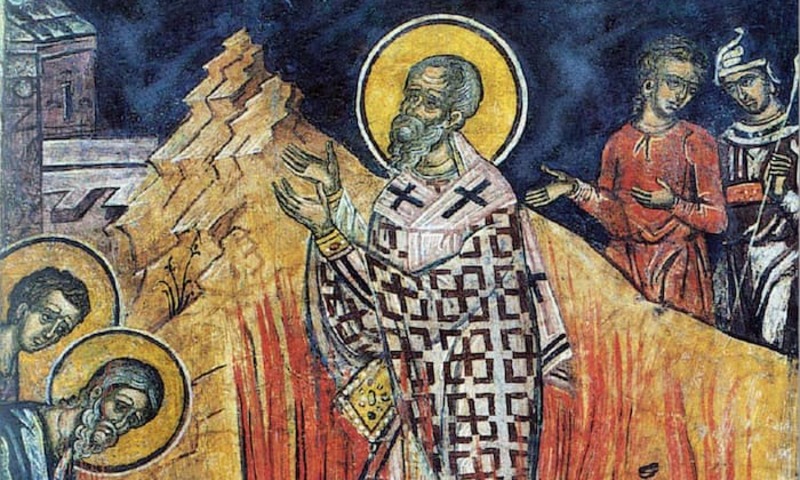
Today is the anniversary of Polycarp鈥檚 death, roughly 1,870 years ago (exact date is disputed). What can we learn from his life and ministry?
Polycarp (c. AD 69-155 or 51-155) is one of my heroes. Trudi and I lived in Polycarp鈥檚 city for two and a half years. My eldest daughter was born there. Later, I wrote my doctoral on the literary and theological relationship between Polycarp and Paul. I鈥檝e written three academic about Polycarp as well as a creative narrative to the Apostolic Fathers, where Polycarp is the central figure in the story. In other words, I love Polycarp and have been deeply impacted by his life and ministry.
In truth, we actually don鈥檛 know a lot about Polycarp, but here are eight things we do know and from which we can benefit.
1. Polycarp was all about the gospel.
In the second and third verses of his letter to the Philippians, Polycarp writes these words (picking it up mid-sentence): 鈥渙ur Lord Jesus Christ, who endured for our sins, facing even death, whom God raised up, having loosed the birth pangs of Hades. Though you have not seen him, you believe in him with an inexpressible and glorious joy (which many desire to experience), knowing that by grace you have been saved, not because of works, but by the will of God through Jesus Christ鈥� (Pol. Phil. 1.2-3, Holmes).
Decades later when Polycarp stood before the proconsul, a powerful local ruler who had the power to execute him or let him live (he executed him), Polycarp offered to make a public presentation of the gospel (Mart. Pol. 10.1). The way Polycarp worded this makes me think that Polycarp had presented formal and public explanations of the gospel in the past. Even Polycarp鈥檚 is described as 鈥渋n accord with the gospel鈥� (Mart. Pol. 1.1 and 19.1)
Polycarp鈥檚 gospel-centricity should be an example to us.
2. Polycarp knew his Bible really, really well.
Have you ever met an older person who knows the Bible super well, not because of being a biblical scholar, but just because of having read the Bible a lot? When I was growing up, such Bible-people often were saturated with the King James Version. Sometimes, such a person鈥檚 knowledge of the Bible ran so deep that it affected his or her regular spoken language, even when not quoting from the Bible!
Polycarp was an old version of this. Polycarp鈥檚 contains many dozens of biblical allusions and quotations mixed in among his exhortations and encouragements. You can tell he loved God鈥檚 Word and read it all the time!
Polycarp鈥檚 example should inspire us to learn God鈥檚 Word well enough that it every part of our being.
3. Polycarp cared about the local church.
As far as we can tell, he spent his entire ministry in one city 鈥� the city of Smyrna in Asia Minor. That鈥檚 where he was ministering when Ignatius of Antioch marched through on his way to martyrdom; that鈥檚 where he was living when the churches of Asia Minor sent him to represent them in Rome; and that鈥檚 where he was martyred as an elderly man. When the people in the stadium started chanting for Polycarp to be brought into the stadium (Mart. Pol. 3.2), he didn鈥檛 want to leave the city 鈥� he wanted to keep ministering there. He only left because his friends insisted that he try to hide from the authorities (Mart. Pol. 5.1).
We can learn from Polycarp how to be faithful in long-term ministry in one place. The lead pastor of the church where Trudi and I have been members for the past twenty-three years, Robert Bishop, has been in pastoral ministry in this one church now for the past thirty-three years. And he鈥檚 still going strong. Granted, that鈥檚 not as long as Polycarp, but is one of many current examples of someone faithfully and passionately serving God鈥檚 people in one locality. We need more examples of people who will plant themselves in one geographical location and make a difference for Jesus in that one place.
4. Polycarp cared about the church worldwide.
Even though Polycarp was rooted in one place, he actively cared about the other churches sprouting up all over the Roman Empire and beyond. He collected the letters of Ignatius for the church in Philippi (440 miles away mostly by roads) and wrote them a special letter about righteousness (Pol. Phil. 13.1-2).
He traveled to Rome (811 miles as the crow flies) late in his life to address the Quartodeciman controversy 鈥� the dating of Easter (Eusebius, H.E. 5.24).
He made it a habit to for 鈥渁ll the churches around the world.鈥�
Even the account of Polycarp鈥檚 martyrdom was sent to the church of Philomelium at their request 鈥� a church that was a long distance away (268 miles by road) (Mart. Pol. Salutation).
Like Polycarp, we need to not only be interested in our local church ministries but also find ways to connect with, support and do shared ministry with people who are at a distance.
5. Polycarp influenced younger Christians.
Irenaeus had connected with and been influenced by Polycarp when he was younger, and looked to him as a mentor and a connection to the Apostolic age. Many years after Polycarp鈥檚 death, Irenaeus referred to Polycarp with the honorable title of 鈥�.鈥�
During his lifetime, younger Christians around Polycarp respected him so much that they vied with each other to take off his sandals (Mart. Pol. 13.2).
We need people who are committed to influencing those who will carry the message of Christ into the next generation.
6. Polycarp contended for sound doctrine against false teachers.
He contended against (Pol. Phil. 7.1-2), and, according to , against and (Adv. Haer. 3.3.4).
Many of us get so easily enamored with interesting and unique ideas that we will not contend for sound doctrine. That was not the case with Polycarp.
7. Polycarp was a man of prayer.
He prayed day and night in the country house while hiding out from the authorities (Mart. Pol. 5.1).
He prayed for two hours in an adjacent room after offering food to the soldiers who came to arrest him. They listened while he prayed for everyone he knew around the world (Mart. Pol. 7.2-3).
He prayed a prayer of proclamation while tied to the pyre just before being burned to death for his faithful witness to the gospel (Mart. Pol. 14.1-3).
8. Polycarp was willing to suffer for Christ.
As I mentioned above, he didn鈥檛 want to leave the city after a young faithful Christian named Germanicus was martyred in the stadium and the people started chanting his name (Mart. 5.1).
At the very end, he had the opportunity to escape from the second house in which he was hiding but chose not to (Mart. Pol. 7.1). He didn鈥檛 want to keep running; he was ready to die for Christ.
I am challenged by Polycarp鈥檚 willingness to suffer and die for Christ 鈥� even to the very end.
鈥斺赌�
The outline for this post is from a lecture I gave to the students in the Torrey Honors College at 51黑料 eight years ago (February 23, 2017).
This and other resources are available at .